The best way to avoid new water spots is to have a drying plan before the car gets wet. Wash when conditions meet your vehicle’s and finish’s care instructions, lay out clean tools that suit them, and leave enough time to rinse and finish properly. And don’t count on a hose attachment labeled “filter” to take the dissolved minerals out of your final rinse.
For a regular wash, the goal is simple: get the dirt and shampoo off, then dry the car completely while conditions are still manageable. You don’t need to buy a water-treatment system to do better. If today’s spot, surface conditions or schedule won’t let you finish, arrange another suitable time or place before you wet the car.
What the water leaves behind
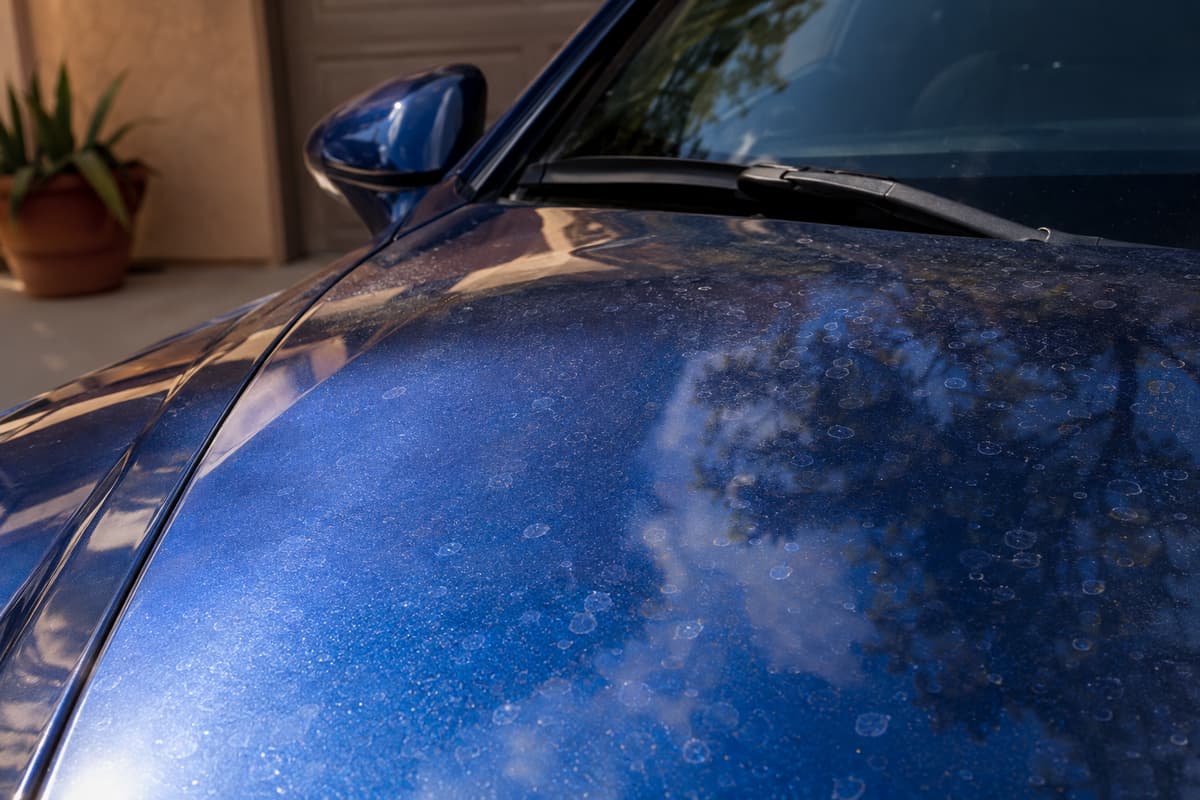
The Las Vegas Valley Water District says calcium and magnesium are the minerals behind local water hardness, and that evaporating water can leave mineral residue. That’s why the last bit of water left on a washed car matters. Preventing new spots and treating old ones are separate jobs, though: a ring that was there before you washed needs its own assessment.
Water dries, minerals can stay
Rinse water
Water can carry dissolved minerals.
Evaporation
The water dries into the air.
Residue
Some minerals may remain on the surface.
Check your setup before the first rinse
Read the care instructions for your car’s actual finish and any coating, film or wrap on it. If you don’t know what products or protection are on the car, sort that out before reaching for a stronger cleaner or a new drying aid.
Check four things before you start:
- Conditions: Can you wash under the conditions your instructions require, including shade and a cooled surface where they call for it?
- Instructions: Do you know the product’s dilution, how to apply it, how to rinse or remove it, and any vehicle restrictions?
- Tools: Are clean, suitable washing and drying tools ready, with separate tools for wheels and bodywork?
- Place and time: Are you allowed to wash here, and do you have time to finish the whole process?
Tesla’s Model 3 manual says not to wash in direct sunlight, and XPEL’s COLOR PPF care guidance calls for hand washing out of direct sun once the vehicle has cooled.
Before the first rinse
Say you have a short window after work, but the car is still sitting in the sun. If you can’t meet the directions, the better move is a different time, place or service.
Check the current SNWA vehicle-washing guidance and any rules from your water provider and property, too. As checked on October 21, 2026, SNWA’s residential garden-hose guidance requires a positive shut-off nozzle, and its rules for personal, commercial and mobile washing differ. Our water-conscious detailing guide covers the booking and wastewater questions.
What does “filtered” actually mean?
Ask what treatment the water gets, especially at the outlet used for the final rinse. The Minnesota Department of Health’s softener guidance notes that hose outlets aren’t necessarily connected to a home softener, so check your own setup.
The SNWA treatment overview explains how ordinary activated carbon, reverse osmosis and ion-exchange softening differ. Carbon alone doesn’t remove hardness minerals. A conventional softener swaps calcium and magnesium for sodium or potassium, so softened water still contains dissolved material. Reverse osmosis uses a membrane to reduce dissolved mineral content.
Deionization, or DI, is different again: resin removes dissolved ions. The Spotless Water Systems explanation treats operating conditions and monitoring the resin’s output as part of using its equipment.
What “filtered” can mean
Scroll across to compare all columns.
| Treatment | What it does | Limit |
|---|---|---|
| Activated carbon | Targets some taste and odor chemicals | Does not remove hardness minerals on its own. |
| Ion-exchange softening | Exchanges calcium and magnesium for sodium or potassium | Softened water still carries dissolved material. |
| Reverse osmosis | A membrane reduces dissolved mineral content | Output depends on the unit and upkeep. |
| Deionization | Resin removes dissolved ions | Depends on resin, operation and checking output. |
Some systems combine treatments. Ask what actually reaches the car and how that output is maintained. Hardness and total dissolved solids are different measures, too; lower hardness doesn’t mean all the dissolved material is gone.
Either way, plan to dry the car completely as your normal routine. If a specialized system comes with a different final-rinse or drying procedure, check its actual operating requirements alongside your vehicle and protection instructions.
Keep washing, rinsing and drying together
Use the method that fits your car and your product. A rinseless product has its own directions.
For a regular wash, Tesla’s exterior-cleaning steps show the sequence: flush away grime and grit before touching the paint, wash with suitable materials, rinse before the soap dries, and dry thoroughly. Gtechniq’s Platinum wash guidance also stresses rinsing off the shampoo and keeping wheel tools and wash water separate from paintwork tools.
Plan the work so you can finish those steps within the directions. Keep an eye on the surface as you go. And don’t turn a fixed panel-by-panel order into a rule if it keeps rewetting areas you’ve already dried or clashes with your product’s method.
If conditions get ahead of you, stop starting new sections. Deal with any product already on the car using its rinse or removal directions. If you can’t do that safely, get advice from the product maker or a pro. Don’t drive somewhere else with shampoo on the paint or improvise a stronger chemical.
Finish with clean towels and a final look
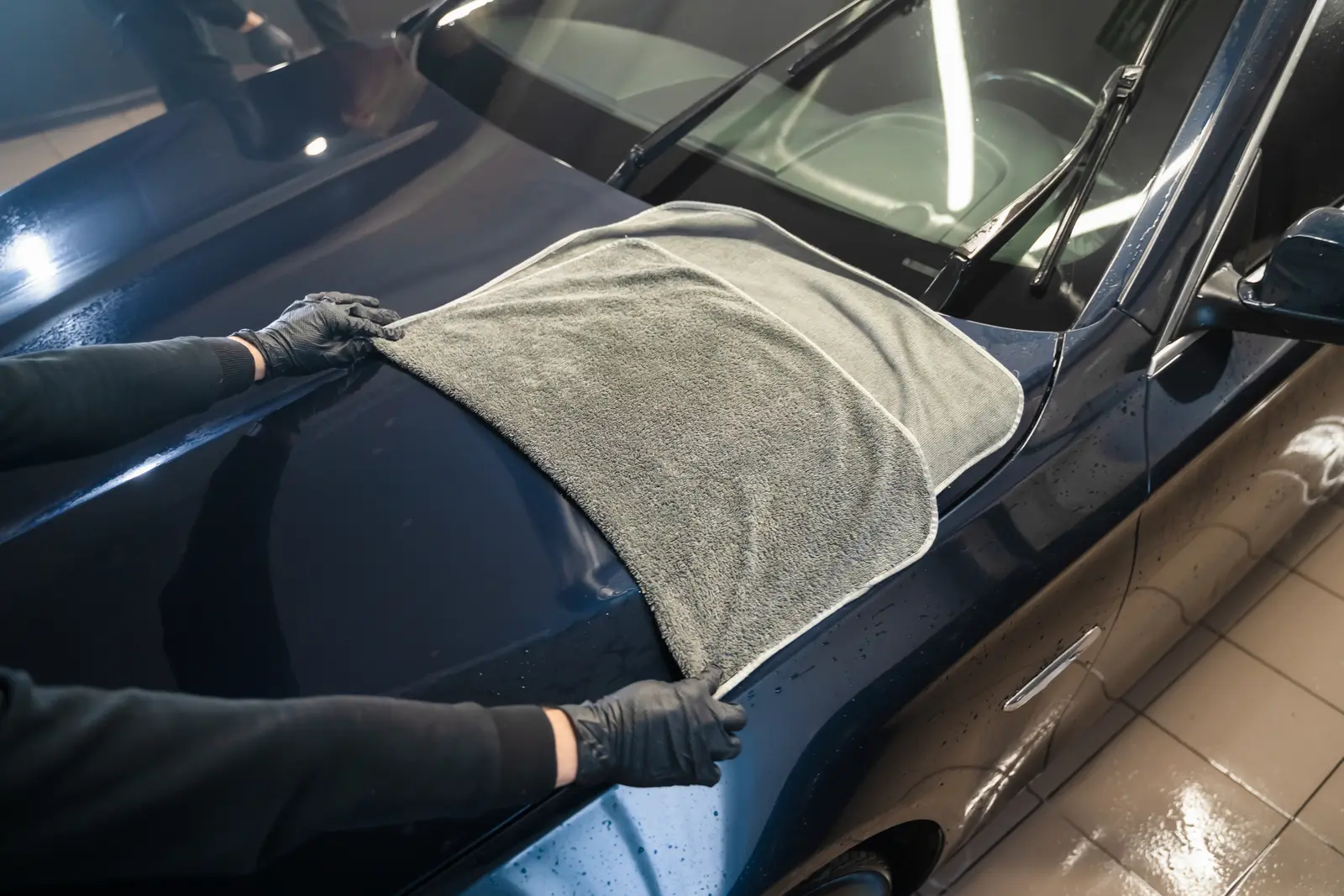
Choose clean drying tools that suit your vehicle and protection-care instructions. XPEL’s FUSION PLUS instructions, for example, call for complete drying with a clean, soft, lint-free microfiber towel or an air blower, without aggressive wiping.
Keep the drying towel off the ground and follow its care instructions; Autoglym’s instructions for its Ultra-Soft Drying Towel specifically mention keeping it off the ground while you work. Have a spare clean towel handy in case one gets dirty.
Look for water you missed
Then take one slow walk around the car, looking for leftover water or fresh drips near mirrors, handles and the panel edges you can reach. Follow the vehicle instructions for door jambs and other parts. Dry what’s left with a method that suits the car.
A mark that’s still there after a proper clean isn’t something to polish away with your drying towel. Our persistent-water-spot guide explains what to do next. For everyday glass problems, see our separate guide to glass streaks and wiper smears; if your view is affected, deal with that before you drive.
Ask about the whole service
ZNT’s mobile detailing service includes hand washing and brings its own spot-free water, power and equipment, without using your water or electricity. For hard-water worries, ask how the wash, final rinse and drying suit your finish and protection. Also confirm suitable space and authorized access under ZNT’s service-location requirements.
Tell ZNT about your vehicle, existing protection and location to ask for a service recommendation and a current quote. Say whether you’re trying to prevent new spots or asking about marks that are already there.