Short version: let the wheels and brakes cool, find out what finish your wheels have, and use a method that both your vehicle’s instructions and the product label allow. Use gentle tools, then rinse and dry properly. If a mark won’t budge, don’t jump to a stronger chemical or a polish.
The wheel’s price, color or “alloy” label won’t settle any of that. Start by knowing what you’re cleaning, and what else the cleaner might reach.
First, find out what finish you have
Dig out the original wheel specification, the purchase paperwork and any refinishing invoice. Painted and clear-coated, exposed polished, plated and anodized finishes can each need different care. Wheel Pros’ care guide, for example, treats its painted or machined clear-coated wheels differently from its exposed polished aluminum ones.
Track down three things:
Scroll to see all columns.
| What you need to know | Where to find it | Why it matters |
|---|---|---|
| The current finish, including any refinishing | Wheel maker, vehicle specification, purchase or refinishing records | The original spec may not describe a later refinish. |
| Any added coating or recent work | The installer’s invoice and aftercare instructions | It brings its own care rules, including early washing restrictions. |
| Vehicle and brake restrictions | Your owner’s manual and the product directions | Cleaner can reach parts beyond the wheel face. |
Say your used car’s wheels were refinished before you bought it. You know they’re black, but there’s no record of the finish or any coating. Gather the wheel identifier and any invoices or installer details, and note what’s still unknown. Ask the wheel maker or refinisher about the finish, and the installer about any coating, before trying another chemical or polish. If the history can’t be found, get an assessment or stick to compatible care.
“Wheel-safe” labels still have exceptions
A neutral or acid-free label is only part of the compatibility check. In its Australian guide, Bowden’s Own describes Wheely Clean as pH-neutral and acid-free, yet specifically excludes carbon-ceramic brakes.
Vehicle instructions can be stricter. The US Tesla Model 3 cleaning manual prohibits chemical-based wheel cleaners. Read your vehicle, wheel and cleaner instructions together, and if they conflict, get it cleared up first. A successful test on a hidden spot doesn’t cancel a clear exclusion.
Recently coated wheels need their own aftercare. GYEON’s Q² Rim EVO page describes easier regular washing and gives its own washing directions. Dust that doesn’t wipe off easily doesn’t prove the coating failed. Ask your installer about maintenance and any early restrictions instead of adding more protection or dry-rubbing the wheel to test it.
Plan the whole clean before you start
Las Vegas has plenty of sunshine and hot summers, according to the National Weather Service’s climate summary. After a drive, you may have to wait before starting on the wheels. Shade helps, but it doesn’t prove they’ve cooled.
Vorsteiner’s care guidance requires its wheels and braking components to cool before cleaning and rules out applying cleaner in direct sun. Don’t touch a disc or caliper to check, and don’t rush it with cold water.
Once conditions and compatibility check out, follow the full method for your wheel:
- Remove loose grime as directed before any gentle contact.
- Use the clean, non-abrasive tool the instructions specify.
- Check the label for application, dilution and contact time.
- Work only on an area you can finish before the cleaner dries.
- Complete the required removal, rinse and drying.
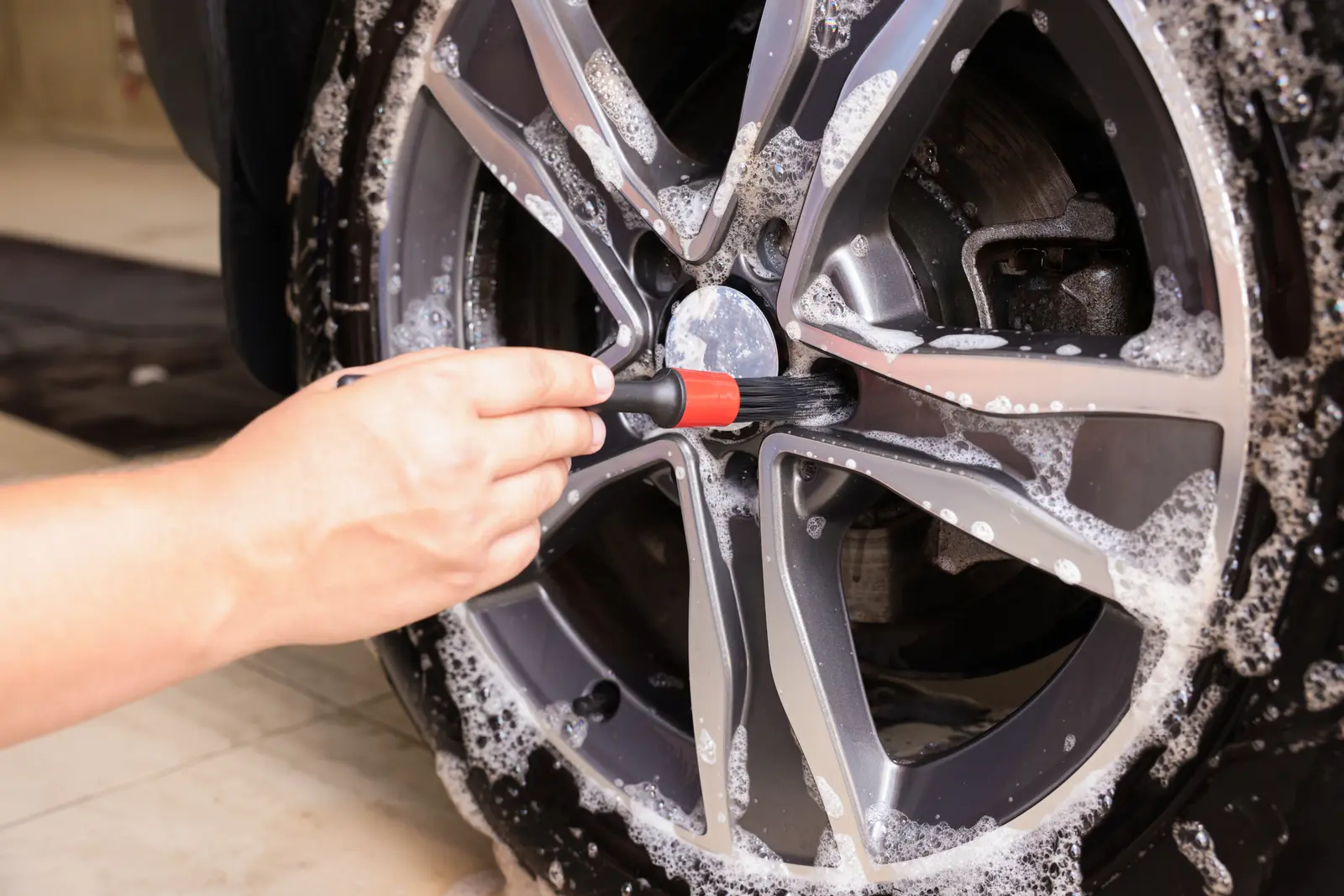
Keep wheel supplies separate from the ones you use on the body. WELD’s care instructions make that distinction and discourage wiping its wheels between washes. A stiff brush or abrasive pad isn’t the fix for a stubborn spot.
If product is already on the wheel, follow its removal directions promptly. If you can’t finish, stop adding product or starting new areas, and check with the maker.
For the wider choice of wash method, see our hand-wash comparison. Our wash-and-dry planning guide covers preparing supplies and managing rinse water across the car.
Know the parts by name
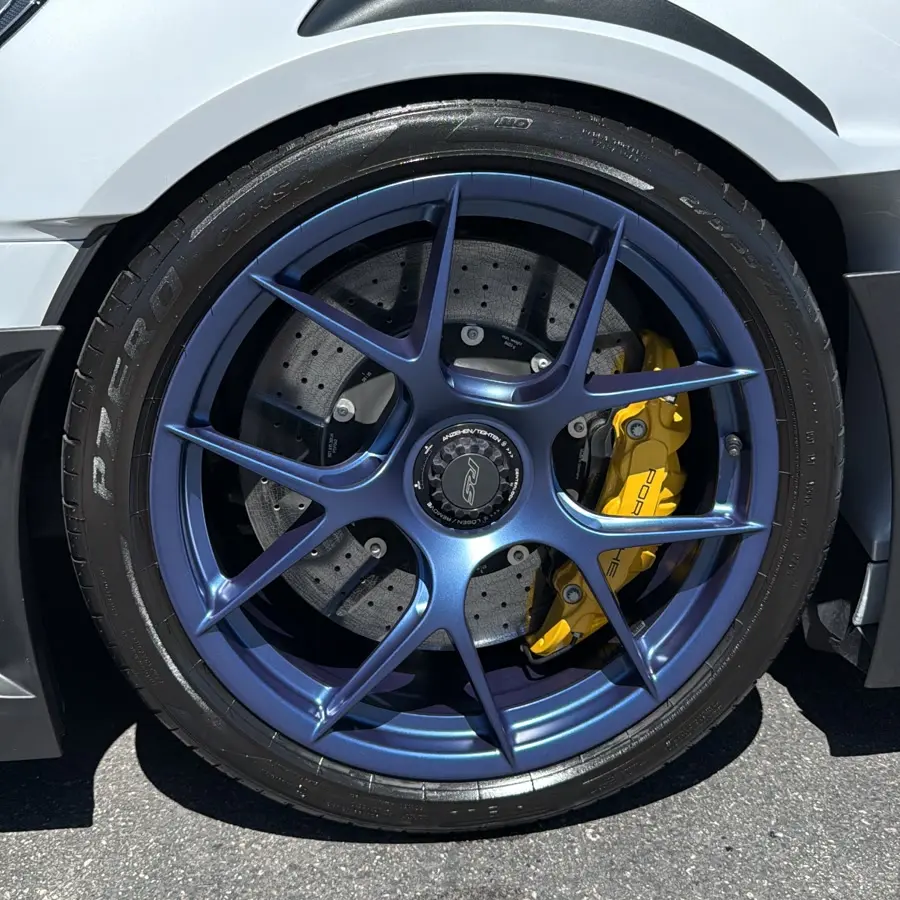
A few terms help you say exactly where the buildup is and what you want cleaned. The face is the visible outer part of the wheel. The barrel is its inner cylindrical surface. The caliper is a brake part behind the wheel, separate from both the wheel and the brake disc.
Know the wheel and brake parts
- Wheel face
The visible outer part of the wheel.
- Wheel barrel
The wheel’s inner cylindrical surface.
- Brake disc
A brake component behind the wheel, separate from the face and barrel.
- Caliper
A brake component, separate from the wheel and disc.
Spoke gaps and nearby brake parts can limit access. Porsche Newsroom’s detailing feature discusses those clearances and keeping cleaner contact with discs and pads to a minimum. Check any restrictions for your car and ask what can actually be reached.
Construction affects rinsing, too. Autoglym’s Ireland Custom Wheel Cleaner FAQ recommends its shampoo instead for split rims, because cleaner can be hard to rinse from the joined surfaces.
When another wash isn’t the answer
If unusual deposits come with noise or braking that feels different, take it to a qualified mechanic before any cosmetic cleaning, even when dirt is visible.
For a purely cosmetic mark, note where it is, what you’ve tried and what changed. Then stop escalating: no stronger chemicals, scouring or polishing. Peeling, missing finish or a curb gouge needs a finish assessment, too. Cleaning can’t replace material that’s gone.
When another wash is not the answer
Noise or braking feels different
Get a qualified mechanical assessment first, even when dirt is visible.
Finish or coating history is unclear
Ask the wheel maker, refinisher or coating installer before another chemical or polish.
A mark or visible damage remains
Seek a finish assessment. Cleaning cannot replace missing material.
Getting help from ZNT
ZNT’s Mobile Detailing Service includes wheel care. Say which areas are affected and ask whether the quoted scope includes barrels and calipers, along with any access and care restrictions for your car. That listing doesn’t promise wheel removal, refinishing, brake service or that every mark will come off, and ZNT’s service terms also limit guaranteed outcomes.
For the bigger question of how much work your car needs, see our service-level guide. To talk through this wheel problem, send ZNT the details: your vehicle, the wheel finish or coating if known, the affected areas, what you’ve tried and your location. Mention what you don’t know, too. Then ask for a recommendation and a current quote that accounts for the wheel’s condition and access.